In this blog, for convenience, we assume a single man looking for a single woman* in the examples.
What are dating sites?
Dating sites are digital marketplaces where supply and demand in love come together directly. The principle is simple: singles create a profile to connect with like-minded people and see if there is a spark.
Online dating offers a barrier-free way to find a partner. Through chat conversations, users build a connection, exchange contact details, and plan physical meetings. Because every user is on the platform with the same goal, making contact is faster, easier, and more targeted than in the physical world.

How do dating sites work and what do they do?
Dating sites act as an advanced search engine for relationships.
Users like you create a personal profile with essential data such as gender, orientation, age, location, and hobbies. By adding photos and a catchy biography, they present themselves to the database.
The algorithm or search function then filters thousands of profiles based on specific preferences. Users select interesting candidates from these results and start a conversation immediately. This process speeds up getting to know each other: through chat, men and women filter their matches and quickly determine if there is potential for a physical date and a long-term relationship.
How does a dating site make money?
Dating sites use various strategies to generate revenue. Although registration is often free, the business model lies in the features that follow. The three most common models are:
- Subscriptions: Users pay a fixed monthly fee for full access. Free members can view profiles, but only paying subscribers can send and receive messages. This model (like Lexa) often ensures the highest quality profiles.
- Freemium: Basic features are free, but you pay for extra reach or functions. Think of 'unlimited likes' or a boost feature to appear at the top of search results. Tinder is the best-known example of this.
- Pay-per-action (Microtransactions): Users pay for each individual action, such as sending a message or a 'like'. This model often charges around 1 euro per message. Note: This model is extremely prone to fraud and forms the basis for almost all fake sites with chat operators.
There are also less direct methods:
- Advertisements: The operator sells advertising space between profiles. Your attention and data are the currency here, similar to social media platforms.
- Affiliate Marketing: The site earns commissions by offering partner products or services, such as restaurant reservations or flower delivery for your date.
Conclusion: Preferably choose a subscription or freemium model. On sites that charge per message (Pay-per-action), you run a significant risk of being scammed by fake profiles.

Are dating profiles real?
Not always.
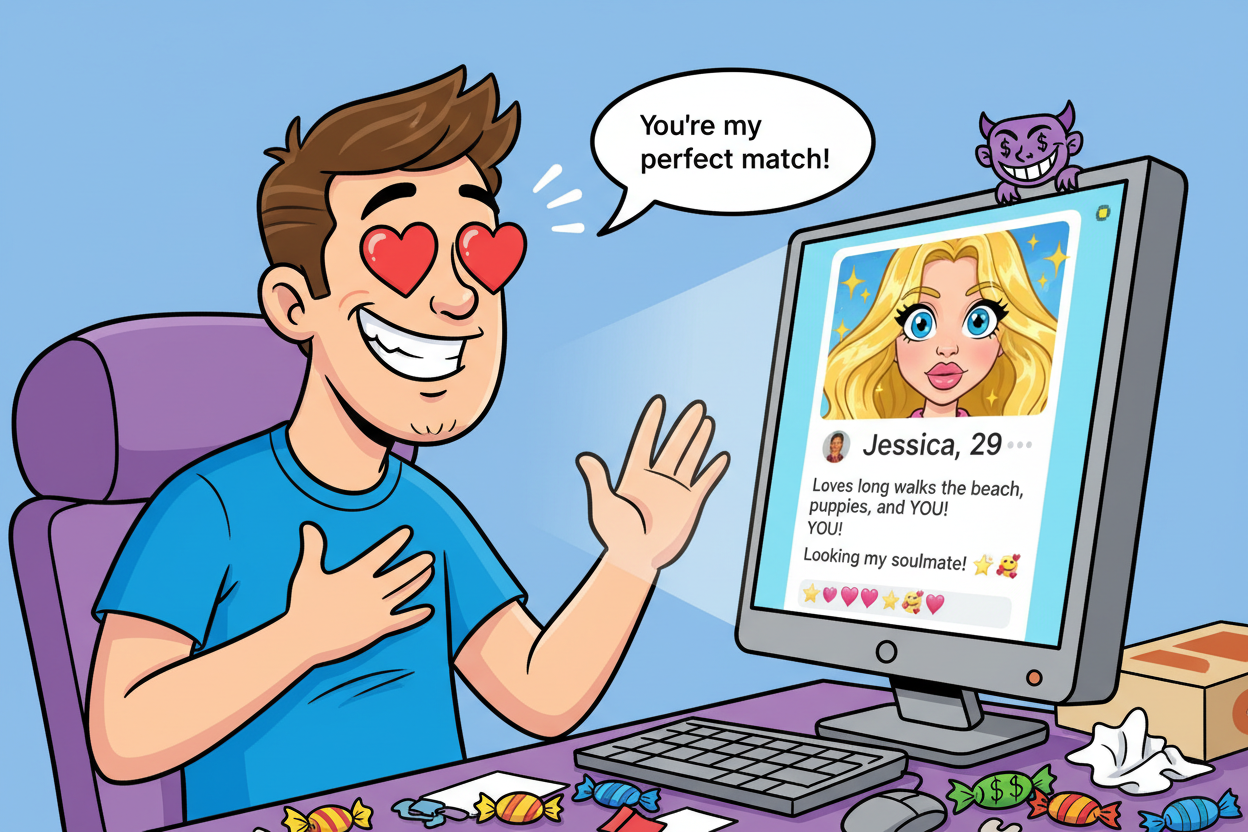
In reality, many platforms contain significantly more fake profiles than the average user suspects. Dating site operators deploy fictitious female profiles as strategic bait to attract and retain male users.
Purely for profit: a high concentration of (seemingly) available women acts as a magnet for paying men. The more activity on the platform, the higher the website’s revenue.
Using these "bait profiles" is a lucrative method for fraudulent dating sites to maximize profits at the expense of the trusting user.
How to recognize fake profiles?
Figuring out whether a profile is fake or real is always more difficult and never 100% certain.
Identifying a fake profile requires a critical eye. Although scammers are becoming more cunning, fraudulent profiles almost always show the same patterns. Use the following strict criteria to verify authenticity:
The Photo Check (Reverse Image Search)
Photos on fake profiles are rarely original. They are often stolen from social media, influencers, or obscure forums. Action: Perform a Google Image Search or Yandex search with the profile photo. Does the photo appear on multiple websites under different names? Then you are dealing with a fake profile.
Besides the photo, the profile’s behavior reveals the real intention:
- Extreme interest: You are flooded with messages immediately after registration. If a profile seems "too good to be true" and you as a user don’t have to make any effort for attention, this is a set-up trap.
- Payment per message: Sites that use microtransactions (credits) per sent message are the breeding ground for fake profiles. The goal is simple: to keep you paying as long as possible.
- Question-driven chatting: The other party constantly asks questions. This is a deliberate tactic to force you to respond, which immediately generates revenue for the website.
- Quickly escalate to eroticism: Fake profiles steer the conversation rapidly towards sex. By arousing you, they disable your rational thinking, making you pay for messages longer.
- Avoid physical meetings: Although they say they want to meet, it never happens. Excuses about illness, work, or safety keep you trapped on the paid platform.
- 24/7 activity: A fake profile never seems to sleep. This is because entire teams of chat operators take turns keeping the conversation going day and night.
Conclusion: Does a profile show several of these characteristics? Then immediately break off contact. You are not communicating with a potential partner but with a commercial system designed to empty your wallet.

Who is behind the profiles?
The fake profiles are often managed by a team of different chat operators.
Behind the screen of a fake profile hides no potential partner, but a commercial chat operator. These are employees hired by specialized companies to conduct thousands of conversations simultaneously.
The reality behind these operators is completely different from what the profile suggests:
- Identity deception: A chat operator can be a man pretending to be a woman, or an older person playing the role of someone in their twenties. Physical reality does not matter; the only goal is to produce convincing text directed at you.
- Teamwork: Because these platforms must be available 24/7, often an entire team works on the same profile. The operator who flirts with you in the morning is a different person than the operator who wishes you good night in the evening. They simply read back the chat history to maintain the illusion of continuity.
- No privacy: Everything you share, from personal anecdotes to nude photos, is logged in a database. The operators use this information purely as ammunition to keep you talking longer.
You will never know who you are really communicating with. To the chat operator, you are not a person but a customer who must generate money.
What are chat operators?
Chat operators are the commercial forces behind a fraudulent dating site. They manage the inboxes of countless fake profiles and write messages with the sole purpose of making the user pay. In the world of chat operators, sincerity does not exist; everything is a role play for financial gain.
In practice, this means the person you are chatting with has a completely different identity than the profile suggests:
Identity switch: A 43-year-old male operator can easily log in as 'Vera' aged 23. The recipient thinks they are connecting with a young woman but is actually communicating with a hired copywriter.
Multitasking: A single operator often manages dozens of profiles simultaneously. He is 'Vera' (23), 'Els' (55), and 'Anneke' (32) all at the same time. He holds conversations with dozens of men simultaneously to maximize revenue.
Shift handover: When an operator ends their shift, a colleague seamlessly takes over the chat. You talk to operator A in the morning and operator B in the afternoon, while the name on the screen remains unchanged. Thanks to extensive chat logs, victims never notice this switch.
24/7 availability: Teams of operators work in shifts together. This keeps the chat never silent and allows the platform to make money from you day and night.
The scale of this industry is enormous. Anyone searching Google for "chat operator" job vacancies finds thousands of ads from shady companies paying people to deceive others. It’s a cold-blooded business model exploiting the search for attention and true love. The chat operator is paid per message and therefore has every incentive never to tell you the truth.

Is a fake profile illegal?
The use of fake profiles lies on the borderline between deception and identity fraud.
When a website steals photos of real people to create fictional profiles, it is a criminal offense. Additionally, the platform breaks the law when it deliberately misleads customers into making financial transactions under false pretenses.
Yet many of these sites operate in a legal gray area by using the following tactics:
- The "Entertainment clause": In the fine print or terms and conditions, they hide texts like: "This website is intended for entertainment; fictional profiles are used and physical meetings are not possible." *
- Legal cover: By placing this disclaimer (often deeply hidden in the footer), they claim the user is aware of the fictional nature of the chat.
- Poor enforcement: Although regulators like the ACM (Authority for Consumers & Markets) can impose multi-million fines, enforcement is complex. Many operators work from abroad or constantly change domain names to stay under the radar.
Conclusion: Although morally reprehensible and often illegal, these sites survive through legal loopholes and hidden disclaimers. The fact that a site "exists" absolutely does not mean it operates legally or honestly.

How to recognize a dating site with fake profiles?
On the surface, these sites seem honest and genuine, but their infrastructure betrays them. Watch out for these five solid proofs:
- Pay per message: This is the biggest warning sign. Reliable sites operate on subscriptions (it doesn't matter how many contacts you make or messages you send); fraudulent sites charge per sent message to profit from every sentence you type.
- Aggressive seduction: Do you receive erotic messages from photo models immediately after registration? This is "clickbait" to lure you directly into an expensive chat.
- Stolen photos: The images are often too perfect. Use a reverse image search; you will often find the same photo on stock sites or social media of influencers.
- The chat loop: The conversations are intense but never lead to a date. Operators avoid any attempt at physical contact or exchanging phone numbers.
- One-way traffic: You are overwhelmed with attention and questions without having to make an effort. If it seems too good to be true, you are talking to a system, not a person.
Conclusion: A site that earns per message does not want you to find love. They want you to keep sending messages and paying.
How OnlyFans often uses chat operators
The concept of the chat operator is also deeply rooted in the OnlyFans industry.
Although fans think they are building a personal bond with a model, the reality is often a business transaction with an external employee. Large accounts outsource almost all their communication to specialized companies: the OnlyFans Agencies.
The interaction on OnlyFans is often managed according to a strict script:
- The "Agency" as intermediary: An OnlyFans Agency acts as a management company that hires chat operators. These operators often work in low-wage countries (such as the Philippines or South America) to keep costs low. They conduct thousands of conversations simultaneously on behalf of the model.
- Personal content from the database: When an operator sells you a "unique" or "special" video, it simply comes from a pre-recorded archive. The suggestion that the content was made especially for you at that moment is a deliberate sales strategy.
- Psychological manipulation: The operators are trained to give you the illusion that the model really likes you. They use psychological techniques to create emotional dependency, making you more willing to pay large amounts (tips) for interaction.
- If you are a man of 50, the operator will say something like: ''I’m tired of all those young guys who don’t know what they want, I’m looking for a mature man who knows what he wants and is there for me.''
- If you are a young guy of 23, the chat operator will say: ''All those nasty old men trying to flirt with me, I’m looking for a young guy who is fit, energetic, healthy, and has time for me.''
You get the feeling that she is really looking for you and genuinely finds you interesting.
- The real conversation partner: You almost never chat with the owner of the account. Behind the laptop is often a male or female operator who uses your profile data to play on your interests.
For the model, this is a purely scalable business model. Instead of chatting for hours herself, she outsources this in exchange for a commission. This allows her to be available 24/7 and maximize revenue, while the "fans" talk to a paid operator they have never met.
In short: On OnlyFans, you often don’t pay for access to a person, but for access to a professionally managed chat system.
How do you know you’re dealing with a chat operator?
Recognizing a chat operator is sometimes difficult because their entire business model is based on maintaining an illusion. Still, there are clear patterns in their behavior that a normal date does not show. Watch out for the following signs:
- The "Always-Question" tactic: A chat operator has only one goal: to make sure you send a new message that you have to pay for. That’s why an operator almost never ends a conversation with a simple statement but almost always with a question. Even in short messages, they keep throwing you a "hook" to keep you talking.
- The chameleon strategy: In a normal conversation, there are sometimes disagreements, but a chat operator agrees with you on everything. Whether you talk about your hobbies, your work, or your deepest desires; the person on the other side mirrors everything you say. It seems like the "perfect match," but in reality, it’s a rehearsed way to quickly build trust.
- Sexual distraction: As soon as you start asking critical questions about the authenticity of the profile or about a meeting, the operator often switches to a very explicit, erotic tone. By making you "horny" or showering you with compliments about your appearance, they hope you lose your rationality and keep chatting out of excitement.
- The eternal date that never happens: This is the most frustrating trait. An operator will often bring up a meeting themselves to give you hope, but as soon as it gets concrete, excuses follow. There is always an emergency, a busy job, or a sudden family situation. Chat operators are strictly forbidden from actually meeting up.
- Fear of external apps: Imagine suggesting switching to WhatsApp or making a quick video call. A real date would find that logical after a while, but a chat operator will always refuse with excuses like: "I've been harassed online before" or "I feel safer here." The real reason is simple: outside the platform, neither they nor their employer earn anything from you.